Why I Train Other Therapists — And Why It Makes Me a Better Postpartum Therapist for You
Why I Train Other Therapists — And Why It Makes Me a Better Postpartum Therapist for You
When most people search for a postpartum therapist, they’re looking for someone who truly gets it — someone who has spent years in the trenches of perinatal mental health, who knows what postpartum anxiety actually looks like beyond the textbook definitions, and who stays current on everything from screening tools to the latest research on maternal mental health. What they might not expect is that one of the reasons I can offer that depth of expertise is because I spend time training other therapists to do this work.

I’m Jerusha Hull, a licensed clinical social worker (LCSW) and PMH-C — a certified perinatal mental health clinician — and the founder of Virtue Counseling, a virtual private practice specializing in postpartum depression, postpartum anxiety, pregnancy after loss, and the full spectrum of perinatal mood and anxiety disorders (PMADs). I also train mental health professionals across the country on how to identify, assess, and support clients through the fourth trimester.
Here’s why that matters for you.
Teaching Deepens Expertise in Postpartum Mental Health
There is a reason that medical schools use the model of “see one, do one, teach one.” Teaching a subject forces you to understand it at a completely different level. When I am preparing a training for other clinicians on identifying postpartum mood disorders, preventing postpartum depression through prenatal planning, or building a postpartum support system with clients, I am not just reviewing material — I am pressure-testing every concept, anticipating the hardest questions, and thinking about the full range of clinical presentations a therapist might encounter.
That process keeps my clinical thinking sharp in a way that benefits every client I work with. The therapist who can explain something clearly enough to teach it is the therapist who can also hold complexity with confidence when you’re sitting across from them (or, in our case, on a video screen together).
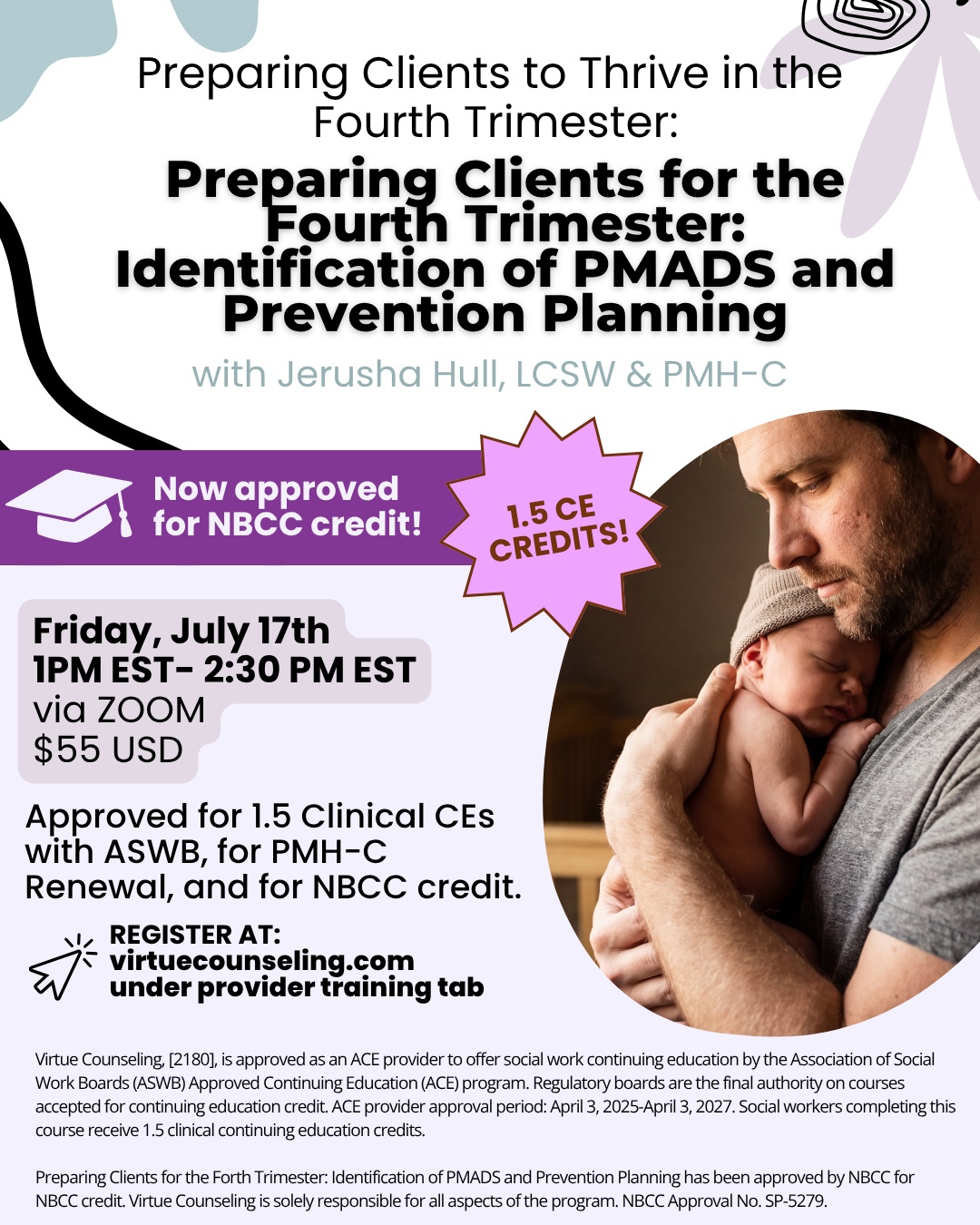
My July Training: Preparing Clients for the Fourth Trimester
On July 17, 2026, I am hosting a 90-minute online training called Preparing Clients for the Fourth Trimester: Identification and Planning through Virtue Counseling. This course is designed specifically for therapists who want to better support their pregnant clients before the postpartum period even begins — because the most effective postpartum mental health support often starts prenatal.
In this training, therapists learn how to assess for risk factors associated with postpartum mood disorders, implement evidence-based prevention strategies, guide clients in building a support network and postpartum plan, and empower families to navigate the fourth trimester with more resilience and confidence.
The training is approved for 1.5 clinical continuing education credits through ASWB, approved by Postpartum Support International (PSI) for PMH-C renewal, and approved by NBCC. In other words, it meets the bar set by the leading national organizations in mental health and perinatal care.
If you are a therapist looking to strengthen your perinatal mental health skills, you can register for the July 17th training here.
What This Means If You Are Looking for Postpartum Therapy
When you search for a postpartum therapist or postpartum depression specialist, you deserve someone who is genuinely embedded in this field — not just someone who lists perinatal mental health as a service. The fact that other professionals seek out my training is a reflection of the depth I bring to this specialty.
At Virtue Counseling, I work with new mothers and families who are experiencing postpartum anxiety, postpartum depression, rage, intrusive thoughts, birth trauma, and the grief that can come with a loss during or after pregnancy. I use evidence-based approaches including Cognitive Behavioral Therapy (CBT), Acceptance and Commitment Therapy (ACT), Interpersonal Therapy (IPT), and attachment-based work — approaches I not only use in session but teach to other clinicians.
My virtual practice is licensed in multiple states, which means postpartum therapy is accessible to you wherever you are. Sessions are private pay, and I can provide documentation to support out-of-network reimbursement through your insurance.
The Fourth Trimester Deserves Real Clinical Expertise
The postpartum period — sometimes called the fourth trimester — is one of the most vulnerable windows in a parent’s mental health journey. Hormonal shifts, sleep deprivation, identity changes, relationship stress, and the enormous pressure of caring for a new baby can all compound in ways that are hard to name and harder to face alone.
Postpartum mood disorders are the most common complication of childbirth, affecting up to one in five new mothers. Yet they are still vastly underdiagnosed and undertreated — often because parents do not recognize what they are experiencing, or because they cannot find a therapist who truly specializes in this space.

That is the gap I work to close — both in my direct clinical work with clients and in the training I offer to the broader mental health community. When more therapists know how to identify and prevent postpartum mood disorders, more families get support earlier. And when I continue to develop and deliver that training, my clients benefit from a clinician who is actively at the forefront of the field.
Ready to Take the Next Step?
For therapists: Join me on July 17th for Preparing Clients for the Fourth Trimester: Identification and Planning. Earn 1.5 CE credits and walk away with practical tools you can use immediately with your perinatal clients.
For new and expecting parents: If you are struggling with postpartum anxiety, postpartum depression, or just feeling like you are not okay in a way you cannot fully explain, you do not have to navigate it alone. Virtue Counseling offers virtual postpartum therapy across multiple states. Reach out through virtuecounseling.com to learn more or request a consultation.
The fourth trimester is hard. You deserve support from someone who has made it their life’s work.