Returning to Work After Maternity Leave: Why It Feels So Hard (and How to Make It Easier)
The night before you go back to work after maternity leave rarely feels like just another Sunday. You may be laying out clothes that don’t quite fit the way they used to, checking the bottle count one more time, and rehearsing a drop-off you’ve been dreading for weeks. If your stomach is in knots, you are not doing this wrong — you are doing something genuinely hard.

As a perinatal therapist (LCSW, PMH-C) who has spent 16+ years supporting mothers through pregnancy, postpartum, and everything in between, I can tell you the return to work is one of the most common — and most underestimated — transitions I help clients navigate. Here’s what makes it so difficult, and how therapy can help you walk back in with realistic expectations instead of impossible ones.
Why Going Back to Work After Baby Feels So Overwhelming
You may be returning to uncertainty
Many women aren’t returning to the same job they left. Teams reorganize. Managers change. Layoffs loom. Some mothers come back to find their role quietly redistributed, or to a workplace culture that feels different than it did nine months ago. Returning to work is destabilizing enough when everything is predictable — returning to uncertainty while also caring for a new baby can feel like standing on two moving floors at once.
The pressure to “do it all”
There is a quiet, relentless story many new mothers carry: I should be able to work like I don’t have a baby and mother like I don’t have a job. That story is a setup. The fear of dropping a ball — at work, at home, with your baby — keeps your nervous system on high alert, and high alert is exhausting to live in.
Perfectionism, meet postpartum
If you’ve always been the reliable one, the prepared one, the one who catches the details — postpartum can feel like an identity crisis. Perfectionism tells you the standard hasn’t changed even though your circumstances have completely changed. That gap between the old standard and your new reality is where a lot of postpartum anxiety and guilt lives.
Worrying about your performance (on very little sleep)
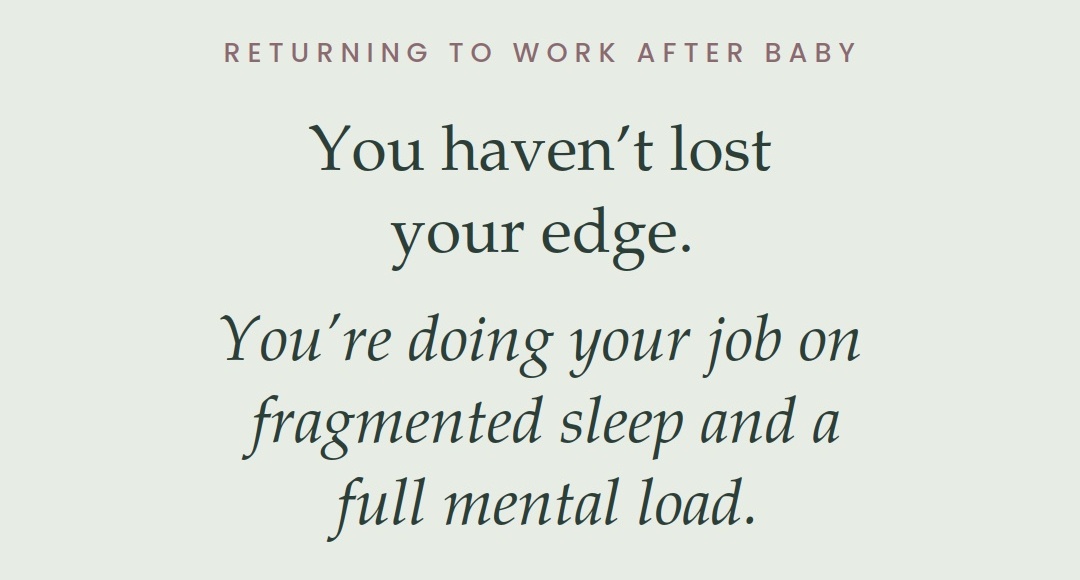
This is the fear clients say out loud the least but feel the most: What if I can’t do my job anymore? When you’re running on fragmented sleep, it can be genuinely hard to follow conversations in meetings, hold details in your head, or find the word that used to come easily. This isn’t a character flaw or a sign you’ve lost your edge — it’s what a brain does on chronic sleep deprivation and enormous cognitive load. But when no one names that, it’s easy to interpret it as failure.

How Therapy Helps You Return to Work Without Impossible Expectations
When I work with mothers preparing for (or already struggling through) the return to work, we focus on two things: building accurate expectations and actively decreasing the pressure of the transition.
We plan for reality, not the highlight reel
Together, we map out what your return will actually look like — the pumping logistics, the daycare germs, the 3 p.m. energy crash, the meeting that runs into pickup time. When expectations match reality, you stop grading yourself against a version of this transition that doesn’t exist. Anticipating the hard parts doesn’t make you negative; it makes you prepared.
We identify what pressure is yours to carry — and what isn’t
Some pressure is structural (your workload, your leave policy, your childcare situation), and some is internal (perfectionism, guilt, the “do it all” story). In therapy, we untangle the two. You can’t fix a broken system by trying harder, and naming that distinction is often the first real relief clients feel.
We build concrete strategies for the transition
Depending on what you need, that might look like scripts for boundary conversations with your manager, a re-entry plan that ramps up rather than slamming into full speed, self-talk that answers the perfectionist voice, or realistic ways to protect sleep and recovery. Using approaches like CBT, ACT, and attachment-based work, we tailor this to your job, your baby, and your nervous system — not a generic checklist.
We make room for the grief and the identity shift
Returning to work often stirs up feelings no one warned you about: grief about time away from your baby, or guilt about the part of you that’s relieved to be back. Both can be true at once. This is part of matrescence — the identity transformation of becoming a mother — and it deserves space, not shame.
You Don’t Have to White-Knuckle This Transition
If you’re dreading your return to work, already back and barely holding it together, or lying awake worried about how you’ll perform on no sleep — support exists, and it helps.
I’m Jerusha Hull, LCSW, PMH-C, founder of Virtue Counseling. I specialize in perinatal mental health and see clients in person in Point Pleasant, NJ, and virtually across NJ, VA, MD, DC, TX, FL, and VT — serving the Jersey Shore since 2021.
Ready to make your return to work feel manageable? [Schedule a consultation] or reach out at [email protected].
Jerusha Hull, LCSW, PMH-C is a perinatal mental health specialist with over 16 years of clinical experience and a graduate certificate in fertility and loss. She is the author of There’s a Fourth Trimester?!, a postpartum workbook available on Amazon.