Managing the Mental Load: Practical Tools for Moms Returning to Work or Raising Multiple Kids

Managing the Mental Load: Practical Tools for Moms Returning to Work or Raising Multiple Kids
If you're heading back to work after maternity leave, or you're deep in the season of raising more than one small human, you already know the mental load is real. It's the invisible running list in your head — who needs a permission slip signed, when the next pediatrician appointment is, whether there's milk in the fridge, which kid is due for new shoes. It almost never shows up on anyone else's to-do list, but it takes up an enormous amount of space in yours.

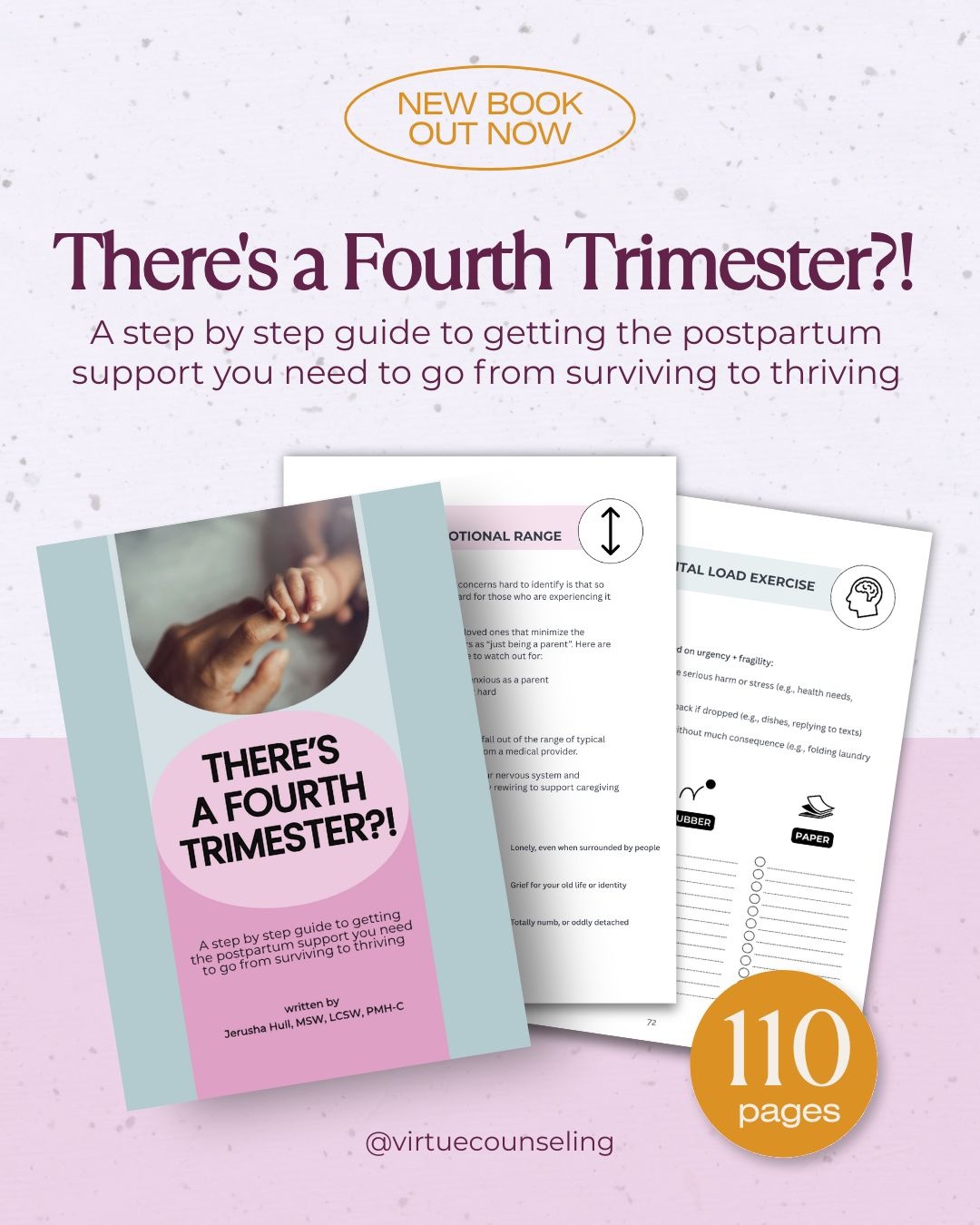
As a perinatal therapist (LCSW, PMH-C), I sit with moms every week who are carrying this load and wondering why they feel so depleted. The load is heavy because it's constant — and because so much of it is invisible, even to the people who love us most. The tools below are the same ones I teach in my practice and in my book, There's a Fourth Trimester?! They won't erase the mental load, but they can make it lighter to carry.
1. Break big tasks into smaller parts
When you have a newborn or a house full of kids, you are going to be interrupted. Constantly. So a task like "clean the kitchen" or "finish the report" is almost designed to make you feel like you failed — because you rarely get to finish it in one sitting.
Instead, break big tasks into parts. "Clean the kitchen" becomes load the dishwasher, then wipe the counters, then sweep the floor. Each part is something you can actually complete before the next interruption. And finishing a small piece gives your brain a real hit of completion, which feels a whole lot better than staring at a whole task you never got to. Progress you can see beats a finish line you never reach.
2. Give yourself grace when things take longer
Everything takes longer than it used to. A trip to the car that once took two minutes now takes twenty. That isn't a personal failing — it's the math of caring for small children.
Build the extra time into your expectations instead of fighting it. When you assume a task will take longer, you stop measuring yourself against a version of you who didn't have a baby on her hip or two kids asking for snacks. Give yourself grace. The goal isn't to move faster; it's to stop punishing yourself for moving at the pace real life actually allows.
3. Prioritize with the glass, rubber, and paper method
Not everything on your plate carries the same weight — but the mental load treats it all as urgent. This is where I teach the glass, rubber, and paper method.
Picture the things you're juggling as three kinds of objects:
- Glass — if you drop it, it shatters, and you can't get it back. Your health, your child's safety, the relationships that matter most. These get protected first.
- Rubber — if you drop it, it bounces. A deadline that can move, a load of laundry, an email that can wait until tomorrow. You can let these fall for a bit and pick them back up.
- Paper — if you drop it, you can crumple it up and recreate it later, or let it go entirely. These are the low-stakes things that feel urgent but aren't.
When you're overwhelmed, you don't have to do everything. You have to protect the glass, let the rubber bounce, and give yourself permission to set the paper down.
4. Let some things stay at the bottom of the list
Look at your to-do list and notice what has naturally drifted to the bottom — the thing you keep moving to "tomorrow" week after week. Here's a question worth sitting with: what if it just… stayed there?
Some of what lives at the bottom of your list belongs there. It hasn't gotten done because it isn't actually essential right now — your life has already been quietly sorting your priorities for you. Give yourself permission to let those things stay unfinished. Then take it a step further and define what doing less looks like for you. Not for the mom next to you at daycare pickup — for you. Doing less isn't failing. In this season, it's often the most honest form of doing enough.
5. Give yourself permission to do it differently
You are allowed to run your life differently than the people around you. What one family needs to thrive looks nothing like what another needs. Maybe you order groceries instead of shopping in-store. Maybe you keep paper plates in the cabinet for the hard weeks. Maybe you go back to work part-time, full-time, or not at all — and any of those can be the right call for your family.
Comparison is a fast track to burnout, because it measures your insides against everyone else's outsides. Give yourself permission to be different, so that you actually get what you need. The point isn't to do motherhood the "right" way. The point is to build a version of it where you can thrive.
You don't have to carry it perfectly — or alone
The mental load is real, and it's heavy, especially in the seasons of going back to work or raising more than one little one. You don't have to carry it flawlessly, and you don't have to carry it by yourself.
If these tools resonate, you'll find many more like them in my book, There's a Fourth Trimester?!, a practical planning guide for the postpartum season. And if you're feeling stretched thin and want real support, I'm a perinatal mental health therapist serving moms across the Jersey Shore and virtually throughout New Jersey, Virginia, Maryland, DC, Texas, Florida, and Vermont. Reaching out isn't one more thing on your list — it's the thing that helps you carry the rest.